West Hollywood is updating zoning rules to support more housing choices, reduce barriers to housing production, and better align local standards with the City’s Housing Element, affordability goals, and anti-displacement priorities. ZIP is a citywide planning effort that looks at housing capacity, design standards, incentives, neighborhood context, and access to transit, jobs, parks, and services.
Zoning regulations shape what can be built in West Hollywood. Through ZIP, the City is studying how to modernize zoning and incentive tools to support new housing, including affordable housing, while also addressing neighborhood context, access to opportunity, and displacement risk. The program includes evaluation of residential and mixed-use standards, housing types, feasibility, and transit-oriented strategies that could apply in different parts of the city.
ZIP is guided by an equity and anti-displacement approach. That includes preserving naturally occurring affordable housing where possible, evaluating how redevelopment affects vulnerable residents, and considering how housing opportunities are distributed across neighborhoods.
- Production. Increase housing supply through a targeted equity-driven strategy that aligns with local housing needs.
- Affordability & Accessibility. Encourage the delivery of affordable and diverse housing choices, meeting residents' needs based on the fair distribution of housing types at every affordability level.
- Equity. Expand access to diverse housing types in all neighborhoods and mitigate displacement risk for those most vulnerable, relying on equity measures to inform the approach.
- Environmental Stewardship. Adopt land use approaches that minimize environmental impacts by leveraging the City's transit and pedestrian infrastructure and concentrating housing near neighborhood and regional amenities.
- Strengthening Neighborhoods. Preserve naturally occurring affordable housing and encourage contextual approaches to development that integrate with existing historical sites and neighborhood identity.
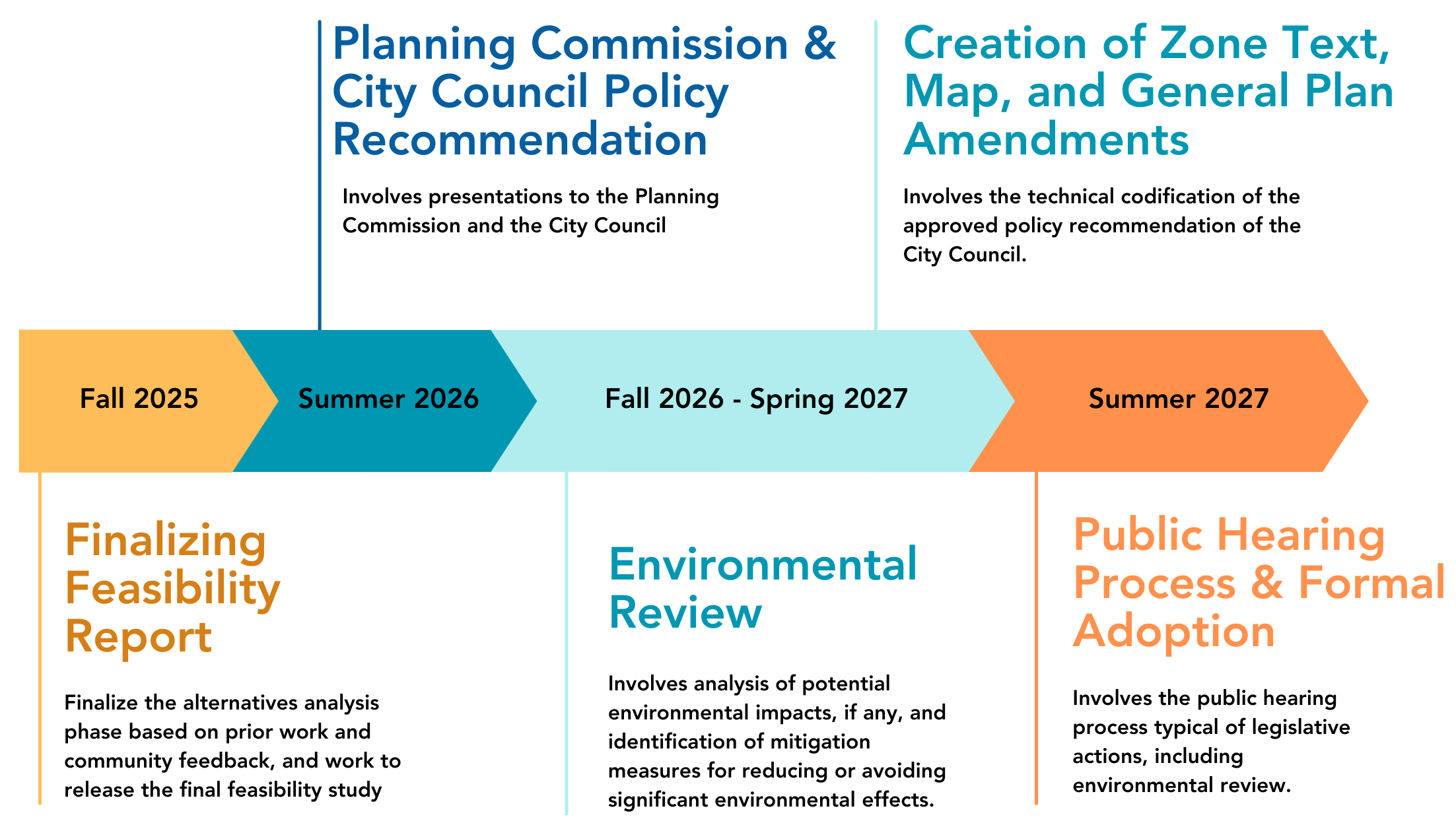
ZIP is still underway. Staff anticipates bringing a comprehensive policy report to the Planning Commission and City Council in summer 2026. After policy direction is received, staff expects to prepare the related General Plan amendments, zoning amendments, and environmental review in fall 2026 through spring 2027, followed by legislative hearings beginning in summer 2027.
Phase 1 outreach found strong support for focusing higher-density housing along commercial corridors and near transit, while also surfacing concerns about displacement, affordability, parking, infrastructure, and neighborhood character. Commercial corridors were widely seen as appropriate for higher density, while views were mixed in existing single-family and low-density areas. There was strong interest in affordable housing for low-income households and housing options for older adults.
Summer 2026: Planning Commission and City Council review of recommended ZIP policy choices. Council provides policy direction to staff.
Fall 2026 through Spring 2027: Staff prepares necessary General Plan amendments, zoning amendments, and environmental review.
Summer 2027: Public hearings are conducted before the Planning Commission and City Council on the completed legislative package.
SB 79 and ZIP: what residents should know
Senate Bill 79 is a state law that takes effect on July 1, 2026. It allows qualifying transit-oriented housing developments on sites zoned for residential, mixed, or commercial development near specified transit stops in urban transit counties. The California Department of Housing and Community Development (HCD) oversees compliance, and each metropolitan planning organization must produce the official map showing qualifying stops, zones, and tiers. The Southern California Association of Governments (SCAG) is the metropolitan planning organization that is responsible for producing this map for cities under its jurisdiction, including West Hollywood.
The Metro Board’s March 26, 2026 selection of the San Vicente–Fairfax alignment as the Locally Preferred Alternative for the K Line Northern Extension is an important planning milestone, but it does not by itself determine parcel-level SB 79 applicability in West Hollywood. For West Hollywood, the local impact of SB 79 remains undetermined. Local applicability depends on whether locations in or near West Hollywood qualify as TOD stops and how they are shown on SCAG’s official map, which has not yet been released. Per SCAG’s website, the agency is currently developing the SB 79 TOD stops and zones map for the region and expects to host a virtual information session in late spring to walk through the map with impacted stakeholders, in advance of taking the map before the SCAG Regional Council in a special meeting in June 2026. For more information on SCAG’s role in this process, visit: https://scag.ca.gov/housing#_housing-tab-3-name
ZIP and SB 79 are related, but they are not the same thing. SB 79 sets a state minimum where it applies. ZIP remains the City’s main local process for shaping objective development standards, frontage and design expectations, transitions, public realm standards, affordability coordination, and any local transit-oriented strategy the City may choose to pursue.
Estimated Timeline
Phase 1 Outreach - Completed
Opportunity Map
Neighborhood Perspectives
Neighborhood Perspectives
Think for a moment about your neighborhood or other neighborhoods throughout the city, and share your thoughts about the physical spaces where people live, work, and recreate, as well as services that support those activities. What do you like about this neighborhood? What would you like to see change?